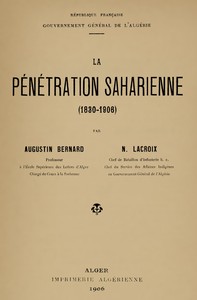
La pénétration saharienne (1830-1906) by Augustin Bernard and Napoléon Lacroix
Forget sweeping epics about empires for a moment. La pénétration saharienne tells a different kind of story. It's a granular, year-by-year account of how France, after establishing itself in coastal Algeria, turned its gaze south to the vast, unconquered Sahara. The 'plot' is the slow, relentless creep of outposts, treaties, and military columns into a region that had long been a barrier.
The Story
Bernard and Lacroix map out a seventy-six-year campaign. It starts with tentative probes from cities like Algiers and Constantine, often ending in disaster as expeditions get lost or are wiped out. We see the French learning—sometimes the hard way—about desert warfare, camel logistics, and the complex politics of nomadic tribes like the Tuareg. The narrative follows the establishment of key southern forts, the shifting alliances with local leaders, and the eventual linking of Algeria with French territories in West Africa. It's a story of infrastructure as much as invasion: telegraph lines, railroads, and administrative districts slowly etching new lines onto a map that had remained largely unchanged for generations.
Why You Should Read It
What gripped me wasn't just the historical facts, but the palpable sense of friction. You feel the resistance—not just from people, but from the land. The desert is a constant character here, an enemy that could defeat an army without a single shot being fired. The authors show how colonial ambition was constantly tempered by reality: thirst, disease, distance, and a deeply rooted indigenous social structure that couldn't be simply swept aside. It removes the romantic veneer from exploration and shows it for what it often was: a difficult, violent, and strategic administrative project. It makes you reconsider what 'conquest' actually looks like on the ground.
Final Verdict
This isn't a casual beach read. It's for the curious reader who wants to move beyond simple narratives of good guys and bad guys in colonial history. Perfect for history buffs who enjoy detailed, source-driven accounts, or for anyone interested in North Africa, desert exploration, or the messy, operational realities of building an empire. Be prepared for a dense, factual journey, but one that offers profound insights into how a region was fundamentally reshaped.