
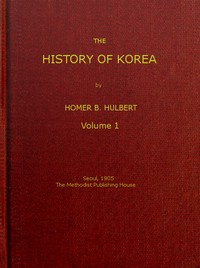
The History of Korea (vol. 1 of 2) by Homer B. Hulbert
Let's be honest, when you pick up a history book called 'The History of Korea, Volume 1,' you might expect a stiff, academic slog. What you get with Homer Hulbert's work is something entirely different. This book feels like a labor of love, written by someone who wasn't just studying Korea from afar but was living in it, trying to understand its soul.
The Story
This volume doesn't follow a single character, but the main character is Korea itself. Hulbert starts with the foundation myths—the story of Dangun, the legendary grandson of a god, who is said to have founded the first Korean kingdom. From there, he walks us through the Three Kingdoms period (Goguryeo, Baekje, and Silla), showing how these rival states warred, traded, and formed complex relationships with each other and with imperial China. The narrative builds toward the unification of the peninsula under Silla. Hulbert uses Korean chronicles, Chinese historical records, and even early archaeology to piece the story together. He's constantly questioning sources, pointing out where myths might have overtaken facts, and highlighting moments where Korean identity was shaped.
Why You Should Read It
You should read this because it has a point of view. Hulbert isn't a neutral observer. He's openly admiring of Korean culture and fiercely defensive of its right to have its own history, separate from China's shadow. You can feel his frustration when he talks about how Korean achievements were often credited to others. This passion makes the ancient politics and battles feel urgent. It's also full of fascinating details—like the Hwarang, an elite youth corps in Silla that blended martial arts, poetry, and spirituality. Reading Hulbert is like having a knowledgeable, slightly opinionated guide showing you around a lost world.
Final Verdict
This book is perfect for curious readers who want to go deeper than a Wikipedia summary. It's for anyone interested in East Asian history who wants a perspective that isn't centered on China or Japan. It's also a great pick for travelers planning a trip to Korea, as it adds centuries of context to every palace and temple you might visit. Be warned, it's an old book (first published in 1905), so some language and historical interpretations are of their time. But that's also part of its charm—it's a historical document, about history. If you enjoy seeing how stories are uncovered and argued over, you'll find Volume 1 to be a totally engaging foundation for understanding a dynamic nation.
Ava Harris
1 year agoI came across this while browsing and it manages to explain difficult concepts in plain English. One of the best books I've read this year.
Kenneth Garcia
1 year agoFast paced, good book.
Emily Clark
1 year agoEssential reading for students of this field.








William Wright
11 months agoHigh quality edition, very readable.