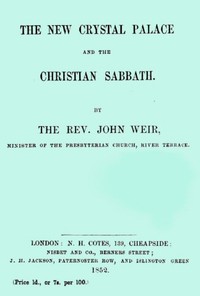
The New Crystal Palace and the Christian Sabbath by John Weir
So, what's this book actually about? It's not a novel in the way we think of one today. John Weir uses a simple story to make a very pointed argument against the new, popular practice of opening London's Crystal Palace—a huge glass exhibition hall—on Sundays.
The Story
Weir sets up a fictional family, the Williamses. They're decent, Sabbath-observing folks until the Crystal Palace starts its Sunday openings. The temptation is too much. The son starts skipping church to go see the wonders. The daughter dreams of the fashion and spectacle. Slowly, the family's day of rest and worship unravels into a day of leisure and spending. Weir paints this as a direct path to moral and financial ruin. He contrasts this with another family who resists the lure, sticking to their traditional Sunday, and implies they are happier and more stable for it. The plot is really a vehicle for Weir's bigger fear: that commercial entertainment is replacing religion as the center of community life.
Why You Should Read It
Honestly, the most fascinating thing isn't the plot itself, but the raw nerve it touches. Reading this is like listening in on a heated 19th-century Twitter thread. You feel Weir's genuine panic. He saw the Crystal Palace not just as a building, but as a symbol of a new, secular, consumer-driven world crashing into old ways of life. His arguments about family time being eroded by public amusements and the pressure to spend money will sound eerily familiar. It’s a powerful reminder that our modern struggles over 'work-life balance' and how we spend our leisure time have very deep roots.
Final Verdict
This book is a perfect pick for anyone interested in the social history of Victorian Britain, the history of religion, or the long-running debate about technology and tradition. It's also great for readers who enjoy primary sources that crackle with the author's personal passion. It's short, it's not subtle, and it's absolutely a product of its time. Don't go in expecting a balanced debate—go in to hear one man's loud, worried, and utterly convinced voice from the past. You might not agree with him, but you'll definitely understand the world he was afraid of losing.