
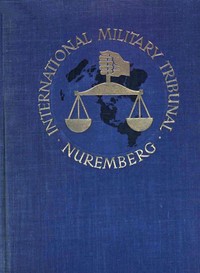
Trial of the Major War Criminals Before the International Military Tribunal,…
This isn't a book with a single author or a traditional plot. The Trial of the Major War Criminals is the official, verbatim record of the first and most famous Nuremberg trial. It's the courtroom transcript. The 'story' is the trial itself, held from November 1945 to October 1946. Twenty-one of the highest-ranking Nazi leaders, like Göring, Hess, and Speer, sat in the dock. They were charged not with losing a war, but with crimes against peace, war crimes, and—for the first time in history—crimes against humanity.
The Story
The prosecution built its case with the Nazis' own documents. They used memos, orders, and diaries to prove the conspiracy to wage aggressive war and the systematic murder of millions. The defense argued the defendants were just following orders. The judges, from the US, UK, France, and the Soviet Union, had to navigate uncharted legal territory. The trial unfolds day by day: shocking film footage from concentration camps is shown, witnesses give heartbreaking testimony, and the defendants try to justify the unjustifiable. In the end, three were acquitted, seven received prison sentences, and eleven were sentenced to death by hanging.
Why You Should Read It
You read this for the voices. It removes all the historical commentary and lets the participants speak. Göring's boastful defiance jumps off the page. The calm, methodical presentation of genocide by the prosecutors is devastating. It makes abstract evil concrete. This trial created the idea that leaders can be held accountable by the world, not just by their own nation. It's where phrases like 'crimes against humanity' entered our vocabulary. Reading it feels like witnessing the birth of a conscience for the modern world, however imperfect.
Final Verdict
This is essential reading, but it's not for a casual beach day. It's for anyone who wants to go beyond the textbook summary of WWII and hear history firsthand. It's perfect for history buffs, students of law or political science, and readers who appreciate primary sources. If you've ever watched a documentary about Nuremberg and wondered, 'But what did they actually *say*?'—this is your answer. Be prepared: it's dense, legalistic, and emotionally heavy. But as a record of a world trying to find justice after unspeakable horror, nothing else comes close.
John Perez
1 month agoAfter finishing this book, the clarity of the writing makes this accessible. This story will stay with me.
Matthew Martin
1 year agoCompatible with my e-reader, thanks.
Patricia Lopez
1 year agoI started reading out of curiosity and the narrative structure is incredibly compelling. Absolutely essential reading.
Robert Torres
3 months agoJust what I was looking for.



Ava Moore
6 months agoAs someone who reads a lot, the emotional weight of the story is balanced perfectly. Highly recommended.